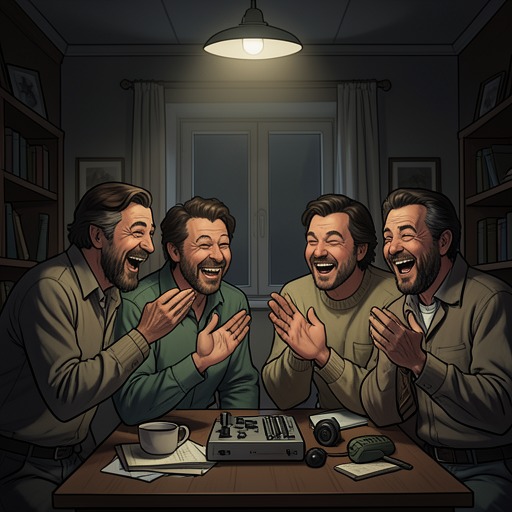
When you lose your laugh, you lose your footing
One Flew Over the Cuckoo's NestWhen you lose your laugh, you lose your footing is McMurphy’s blunt account of humor as a form of resistance. In the ward, laughter marks the difference between being cowed by Nurse Ratched and retaining some capacity to answer her; it also becomes a fragile bridge between patients who have learned to stay silent. The expression gains force not as a promise that laughter can defeat authority outright, but as a measure of whether its pressure has made resistance feel impossible.
The Maxim and Its Target
McMurphy introduces the idea while urging the patients to show that they still have some nerve. He says he has not heard anyone laugh since entering the ward, then warns that a man who lets a woman beat him down until he can no longer laugh may begin to think she is tougher than he is. In this account, laughter is an “edge”: it interrupts the belief that Nurse Ratched’s authority is invincible. McMurphy does not treat it as mere entertainment. It is a sign that the patients have not entirely surrendered their judgment or their ability to respond.
The expression also speaks to the patients’ particular vulnerability to being defined by others. Billy Bibbit identifies Chief Bromden as deaf, describes him as frightened, and reduces him to what he can do on the ward: sweep. Nurse Ratched, meanwhile, invokes the rule that patients remain seated during meetings, and Dr. Spivey explains that the rule maintains order. Against this language of labels and regulation, McMurphy’s appeal to laughter proposes a different kind of footing: not a formal status granted by the institution, but a capacity to resist its account of who the patients are.
From Private Humor to Collective Action
McMurphy’s conduct gives the maxim a practical context. When the ward’s schedule prevents patients from watching the World Series during regular television time, he proposes doing the cleaning at night instead. Nurse Ratched rejects the change, citing the delicately balanced schedule. At first, the Acutes say nothing when McMurphy asks what they think. Cheswick is the lone patient to rise when McMurphy calls for a vote, and the other men look around before deciding whether to join him. Their hesitation shows how difficult it is to turn private frustration into a public act.
Later, when Nurse Ratched puts the question to the group again, McMurphy raises his bandaged hand first. The sight of it is followed by the other Acutes’ hands emerging from the fog, one after another, until all twenty have voted. Their vote concerns television hours, but Chief Bromden understands it as a stand against more than the schedule: the men are also resisting Nurse Ratched’s effort to send McMurphy to the Disturbed Ward and her long pressure on them. The shift from silence to raised hands gives the maxim a collective dimension. Laughter may preserve a person’s footing; a shared act can help others find theirs.
Laughter, Trust, and Its Limits
The expression’s meaning is not simply that McMurphy is always joking. After Chief Bromden begins to speak, McMurphy gives him a package of Juicy Fruit gum that he won in a pennies game with Scanlon. Bromden manages to thank him, and McMurphy laughs at how out of practice his voice sounds. Bromden tries to laugh with him, but the sound comes out more like crying. The moment makes the maxim tender as well as defiant: laughter can accompany a first, difficult return to speech, but recovery is neither effortless nor complete.
The ward’s humor also exists beside mistrust. Dale Harding defends McMurphy as a shrewd man who is open about making money from the patients, rather than pretending to act from pure motives. His elaborate praise of McMurphy’s con artistry is comic, but it acknowledges the complications in their alliance. Laughter does not erase self-interest or guarantee agreement; it allows the patients to recognize those complications without making McMurphy’s every action a selfless gesture.
The Silence That Follows
A later shower-room scene tests how far that shared footing has endured. The patients are laughing and teasing one another while an aide applies salve, but the room goes quiet when he reaches George Sorensen, who avoids soap and will not accept a towel. The men recognize that George is about to be forced into an encounter the evening-shift aides had previously avoided. In that sudden silence, they understand why they had been wrong about McMurphy: the laughter has stopped at the point where the group sees the danger and its own inability to prevent what is coming. The maxim thus describes a real resource, not an invulnerability. Humor can loosen fear and make solidarity audible, but the loss of laughter still registers how quickly coercion can close around a patient.